Systems of exploitation. Reverse dominance. The governed are the inner circle.
Benevolent leadership or rule can raise us above the average and draw us away from evil pied pipers. An ideal political system tends to promote the noblest to authority and keep would-be tyrants in check, while maintaining competitive organizational efficiency. Authority should flow not merely from top-down but also from bottom-up to ensure a fair and equitable relationship between ruler and ruled and make use of both strong leadership and the brilliance dispersed among the population. This “balanced authority” is the principle of democracy, but as we explain in this article, real democracies have failed to thrive in contemporary times for a very important reason.
Oligarchy
We tend to imagine a powerful minority pulling the strings because we intuitively know this is where power lies, despite any facade of ‘the people’ or head of state ruling. A dictator relies mostly on the influence of their personality and is heavily reliant on their inner circle; in other words a dictator has loyalty but not forcible power. Whereas the populace are too large, disorganized, and distracted to make good decisions efficiently, as well as being “sheep-like” and herdable by the fewer “shepherds” or “wolves”. Unlike highly “eusocial” animals like ants and bees, humans have evolved to organize in small groups with flexible hierarchies. This manifests as a tendency for large civilizations to turn into de facto oligarchy (rule by the few).
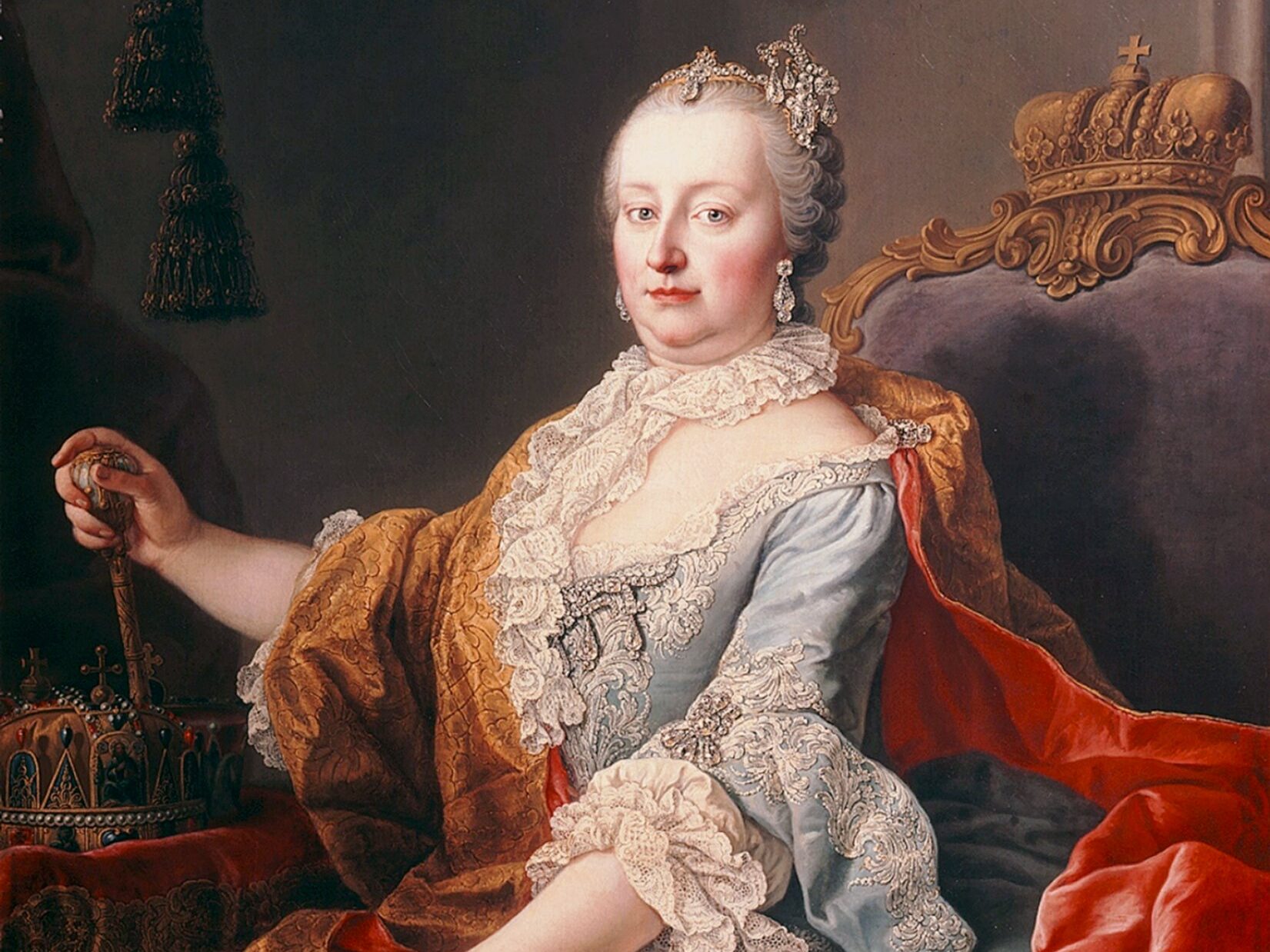
[img: Rothschilds | Dynasty | Royal family Text: Powerful rulers. Able to pass down power generationally.]
Cite: The Cartel Party Thesis
Oligarchy is easily resisted in traditional small communities or “tribes”. Thanks to their manageable size and shared resources, they tend to have flat hierarchies and decisions are highly consensus-based, often making sure everyone is in agreement. Typically, a single leader is deferred to, not that they usually have “power over” anyone. Being intimately known to the group, the leader is far more likely to be trustworthy, who is themselves in a better position to empathize with their people. Their humble position of authority makes “corruption by power” less likely. They are constantly held accountable and have to seriously fear the disapproval of regular people, including minority opinion.
All humans have inherited paleolithic, tribal instincts. The right, dominated by archetypal wartime mentality, romanticize loyalty and strong, decisive leadership by an individual. The left’s peacetime mentality romanticizes inclusivity and group deliberation.
The agricultural revolution saw rapid population growth and with it social stratification and the formation of ruling classes, but prior to the population explosion of the industrial era there was greater success in maintaining genuine democracy. For example the participatory democracy of ancient Athens (albeit only “free men” were allowed to vote.) However, this too struggled with the aforementioned issues.
“Direct participation was a hallmark of Athens’ democracy, but it frequently encountered obstacles like the influence of mob mentality and hurried decision-making.”
https://en.m.wikipedia.org/wiki/Athenian_democracy
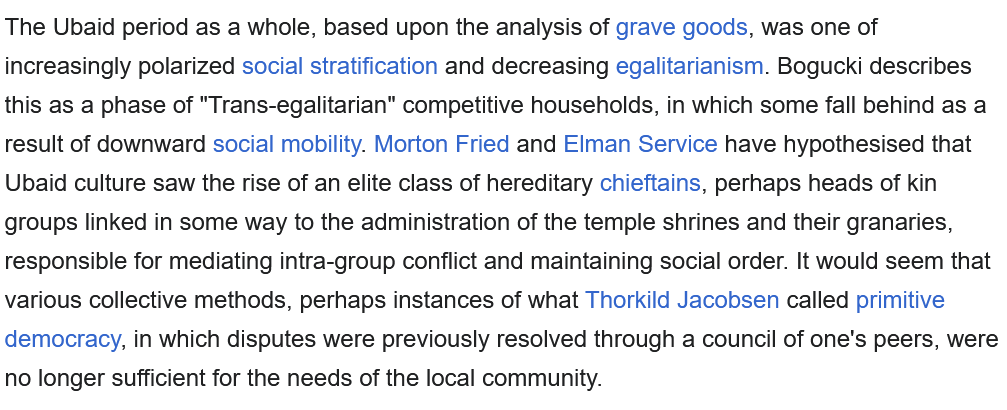
Even the earliest known civilization, Sumer, suffered the socially-stratifying effects of a large population. “The Ubaidians, though never mentioned by the Sumerians themselves, are assumed by modern-day scholars to have been the first civilizing force in Sumer.”
A small size-limit of harmonious and efficient organization is ideal in order to minimize the need for ant-like conformity (dealing with 2 different opinions on the same issue is annoying, 100 is a logistical nightmare.) This way the oppressive power of the community itself is also minimized; if for example the “general consensus” excludes certain members or wishes to commit atrocities against other communities or species. Anarchy (in practice really just direct consensus democracy) is theoretically an extremely powerful political system thanks to the broad unity of society, but this ironically also makes it the most tyrannical were it realistic on a large scale.
Sociocracy
A possible solution to the ‘iron law of oligarchy’ (so named by sociologist Robert Michels in his 1911 book Political Parties) would be if everyone organized into small, autonomous communities (or “villages”) which then form into larger coalitions (confederations) with consensus-based leadership. Villages elect their leaders or representatives, forming a council. Confederations can group together to form super-confederations, and so on. The point is to ensure full cooperation at every level, keeping power balanced while still allowing strong leadership, large population size, and no need for everyone to be heavily involved in politics.
The most prominent and successful example of this was the Mongol Empire led by Genghis Khan.
Another example is the Haudenosaunee Confederacy.
“the tribes united in a common council composed of clan and village chiefs; each tribe had one vote, and unanimity was required for decisions.” https://www.britannica.com/topic/Haudenosaunee-Confederacy
The Zulu Kingdom
The United Tribes of New Zealand
https://en.m.wikipedia.org/wiki/United_Tribes_of_New_Zealand
In the video game This Land is My Land, you rise against the colonizers by uniting and leading many tribes.
Tribalism vs Nobility
Despite their protection against internal tyranny, obviously not all tribes and tribal confederacies will be good. While a tribe leader is likely to be trustworthy to the group, they’re also often expected to lead raids and warfare against other groups. Favoritism toward one’s tribe is known as tribalism. This tends to scale rather than simply being discouraged when tribes are united or dissolved into larger units; for example nationalism at the level of nation, racism at the level of race, and speciesism at the level of species.
The reason for tribalism is Darwinian: Exploiting others is often a more competitive strategy than working together.
Ecosystems can only support a certain density of humans, which is very low for hunter-gatherer, subsistence agriculture, or nomadic herder lifestyles. Great distances and difficulty of communication between tribes made cooperation difficult, whereas a single raid or territorial conquest could put the aggressor at a great advantage or secure their tribe’s survival. When alliances were possible they still experienced these limitations with outsiders.
However, diversity among indigenous peoples and their survival conditions has been immense and tribes who valued peace have at many times thrived. Some notable examples are:
Bushmen
Choctaw
Hadza
Hopi
Ifaluk
Ladakhi
Lenape
Moriori
Quechua
Samoan
Tibetan
Tikopia
Tupi
Zuni
(need to revisit this after working on ‘Nobility’ to figure out what values a tribe would need to select noble leaders)
Noble tribe confederacies are something we believe has promise as a popular grassroots movement. We outline ways we can achieve this in Community Outreach.
editing notes
Those expected to obey against their will should be compensated. This would not entail withholding anything which they’re already entitled to, or providing anything which gives them an advantage over others.
Authority needs to constantly be challenged.
Local management
Hierarchy of Tyranny